.avif)
TL;DR

Leads come in from forms, product events, intent signals, and CRM updates. Someone has to stitch all of that into a pipeline that actually converts.
Usually, that someone is doing it manually, or through a tangle of automations that break whenever any one integration updates.
Cargo was built to replace that tangle.

It calls itself an AI revenue orchestration platform, and the pitch is straightforward: instead of connecting ten tools with webhooks and hoping they stay in sync, you build multi-agent workflows that extract, enrich, qualify, and engage leads automatically.
Research Agent finds and verifies the contact. Qualification Agent scores them against your ICP. SDR Agent fires the first outreach.
All of it runs without a human manually triggering each step.
It is a genuinely ambitious vision, and the Y Combinator pedigree, $19.4M Series A, and customer list including Descript, Gorgias, Ashby, and Weights and Biases suggest the market is taking it seriously.
Whether it is the right tool for your team depends heavily on your technical capacity and your budget tolerance for a credit model that has three separate dimensions.
This review covers what Cargo actually delivers, what it costs, where it earns its place, and where it consistently falls short.
One distinction upfront: Cargo is a data orchestration and workflow automation platform. Its SDR Agent handles outreach tasks, but there is no native LinkedIn connection request automation, no LinkedIn message sequencing, and no LinkedIn inbox management built into the platform.
If LinkedIn outreach is part of your prospecting motion, SalesRobot covers that execution layer directly, and we address how the two tools sit alongside each other toward the end.
Cargo: What You Need to Know
✅ No feature gating across any plan:
Every Cargo plan, including the free tier, includes all four AI agent types, all workflows, all data models, and all 100-plus integrations. The only variable between plans is how many credits you have and what level of support you receive. This is a genuinely unusual and customer-friendly pricing philosophy for a platform at this price point.

⚠️ The three-dimensional credit model makes cost forecasting difficult:
Cargo uses three separate credit pools: enrichment credits, orchestration steps, and storage inserts. Each workflow action draws from a different pool depending on what it does.
Teams cannot simply multiply contacts by a flat per-contact cost. Estimating monthly credit consumption before running workflows requires either prior experience with the platform or a detailed breakdown from the sales team.
✅ Y Combinator backing, $19.4M Series A, and SOC 2 Type II certification:
For a platform in this category, the combination of institutional validation, meaningful venture funding, and a recognized security certification reduces the counterparty risk that comes with building critical GTM infrastructure on a newer tool.

⚠️ The free plan has 100 one-time credits, not a recurring monthly allocation:
The free tier gives you 100 enrichment credits, 10,000 orchestration steps, and 100,000 storage inserts to use in total, not per month. For most workflows, this is enough to explore the interface and run one or two test sequences but not enough to evaluate data quality against a real prospect list at volume.

✅ Multi-agent workflow orchestration is the category's strongest use case:
Cargo's core differentiation is not any single agent in isolation but the ability to chain Research, Qualification, and SDR agents into a single automated workflow that runs end-to-end without human intervention at each stage.
For RevOps teams that currently manage these handoffs manually, the orchestration layer is where the platform delivers the most meaningful time savings.
⚠️ Independent public reviews are near-zero:
As of 2026, Cargo has only a minimal G2 profile with negligible review content, zero reviews on SourceForge, and negligible presence on Reddit and other independent forums. Notable enterprise customers are listed on the website, but the absence of third-party review coverage means buyers making significant budget commitments have very limited external validation to draw on.

Key Features
AI Research Agent
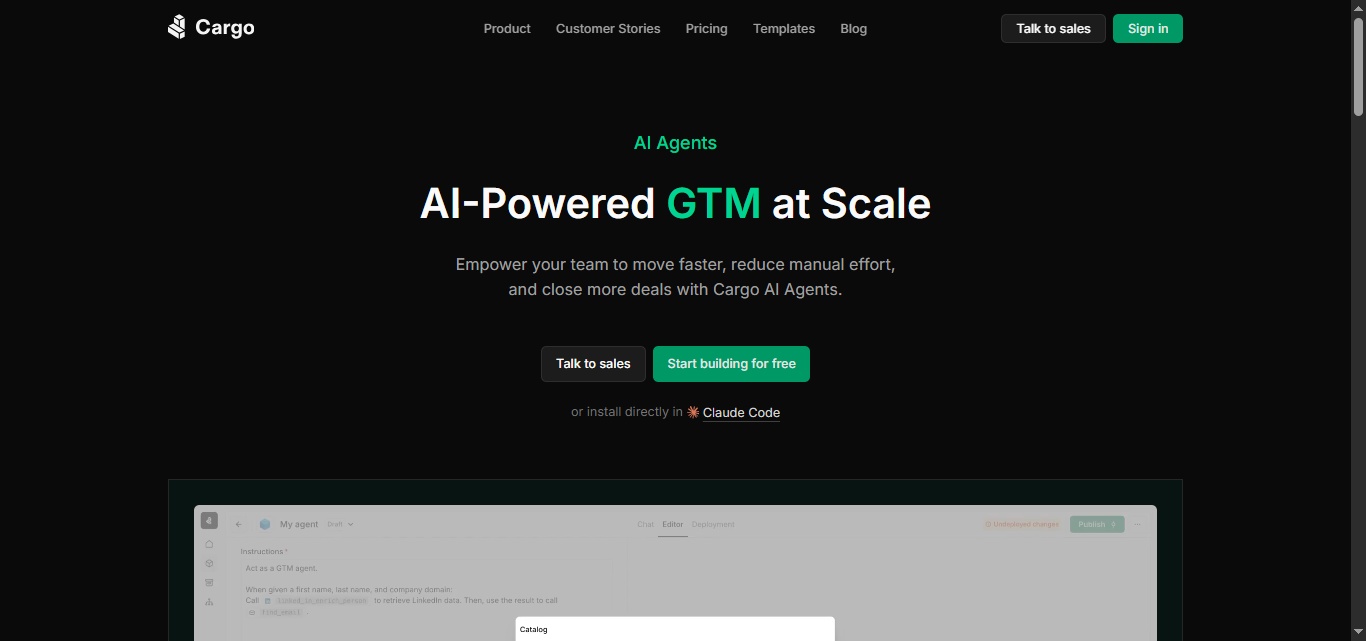
Cargo's Research Agent autonomously finds, validates, and enriches lead and company data without manual effort. It gathers contact information, checks for CRM duplicates, and enriches profiles with company details, firmographics, recent news, hiring signals, and technology stack data by connecting to Cargo's enrichment provider network.
The agent runs automatically as part of a Play rather than requiring a human to trigger each lookup individually. For teams that currently rely on SDRs manually researching prospects before outreach, this replaces the most repetitive part of the pre-outreach workflow.
AI Qualification Agent

The Qualification Agent scores and categorizes incoming leads in real time based on fit and intent signals you define.
It applies your ICP criteria automatically, filtering which leads move forward in the workflow and which are deprioritized, so reps only receive leads that meet your threshold rather than working through an undifferentiated list.
The scoring logic is configured by the user. Cargo provides the framework and automation; your team defines the qualifying criteria. Teams with clearly documented ICP attributes get more value from this agent than teams that are still iterating on what good fit looks like.
AI SDR Agent
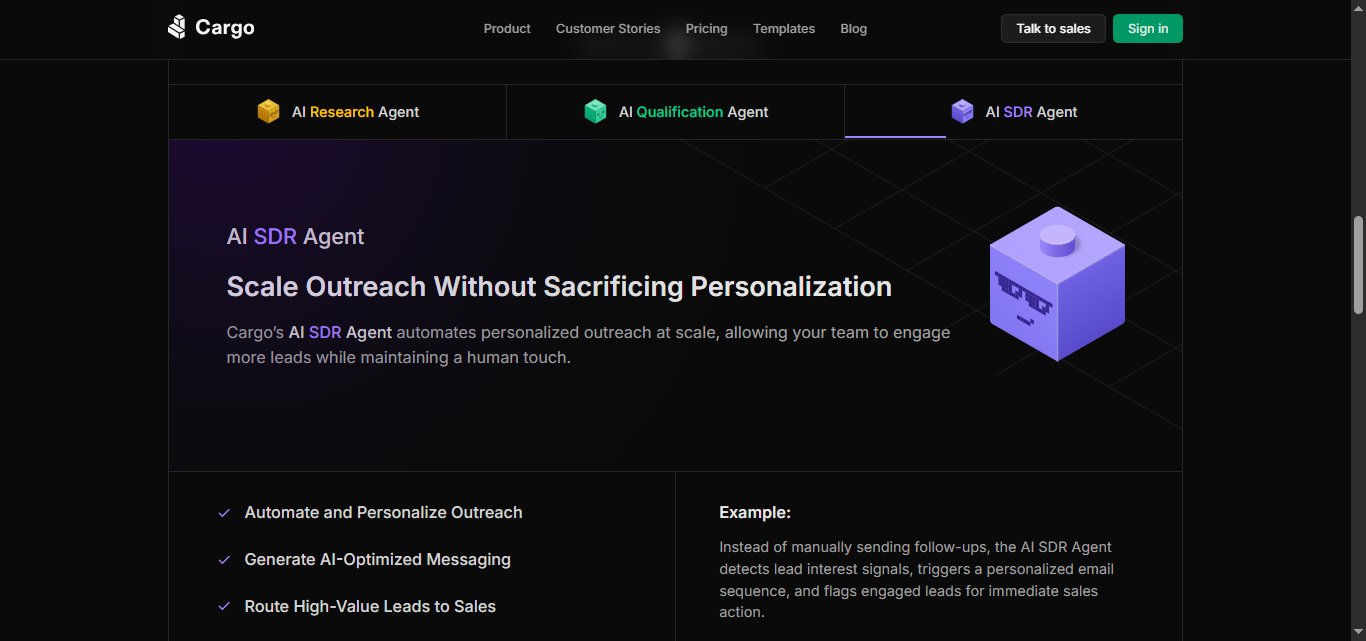
The SDR Agent handles personalized outreach across email and task creation. It generates outreach copy based on the enriched data the Research Agent has gathered, personalizing messages with context about each prospect rather than filling in static templates.
This is not a native LinkedIn automation tool. The SDR Agent handles email-based outreach and can trigger tasks in connected tools. For LinkedIn-specific outreach sequences and connection requests, an external LinkedIn automation tool is required. Cargo integrates with Apollo, Outreach, and Instantly for outreach execution.
Custom Agent
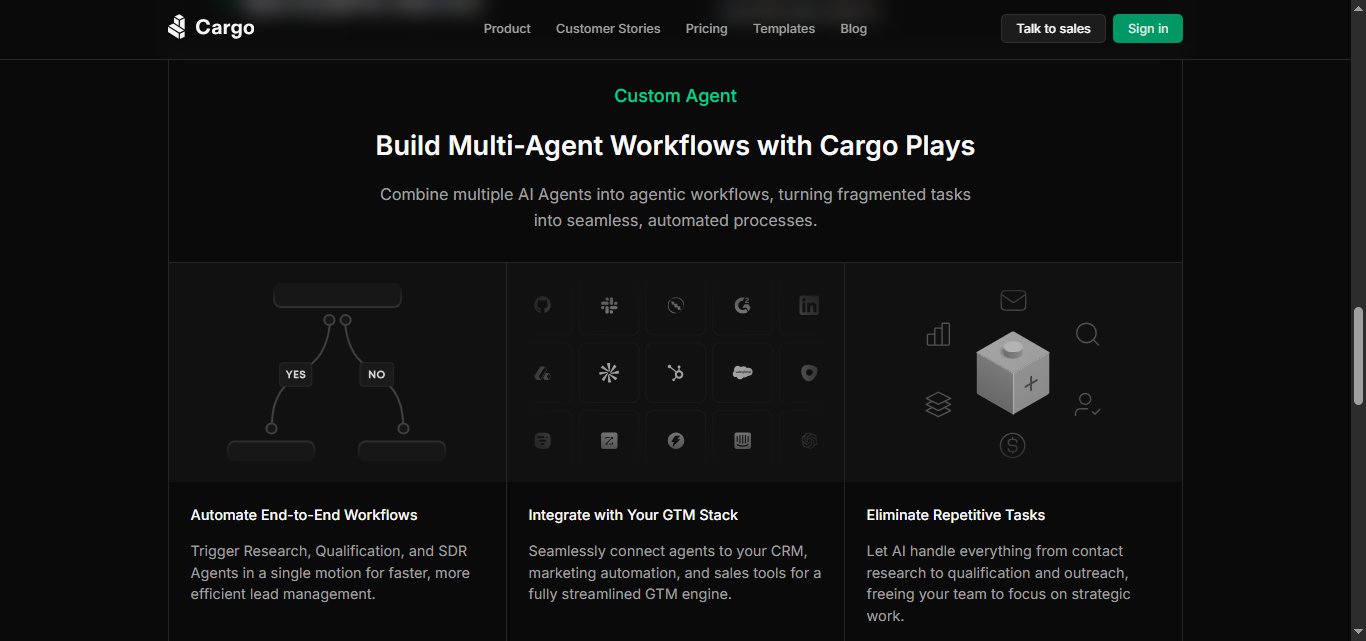
Beyond the three pre-built agent types, Cargo allows teams to build custom agents for specific workflow requirements. Custom agents can be configured through the visual interface without code, or built programmatically using Cargo's API and CLI.
This is the feature that gives GTM engineers the most flexibility and is the primary reason technically advanced teams choose Cargo over simpler automation tools.
Plays

Plays are Cargo's workflow sequencing layer.
A Play chains multiple agents and actions together into an automated end-to-end process.
A typical Play might trigger when a new inbound lead arrives, run the Research Agent to enrich the contact, pass the enriched data to the Qualification Agent to score fit, and then route high-fit leads to the SDR Agent for first outreach, all without human involvement at any handoff point.
Cargo provides a template library to give teams starting points for common GTM workflows rather than building from scratch. These cover use cases like PLG expansion, inbound enrichment, outbound prospecting sequences, and account-based workflows.
Tools

Tools are Cargo's integration and data extraction layer.
They connect to external data sources, CRM systems, marketing automation platforms, and outreach tools, giving agents the inputs they need and providing the destinations for enriched data.
Cargo integrates with over 100 tools including Salesforce, HubSpot, Apollo, Outreach, Instantly, Clearbit, Albacross, Slack, and more. The connector ecosystem receives weekly updates.
Data Models
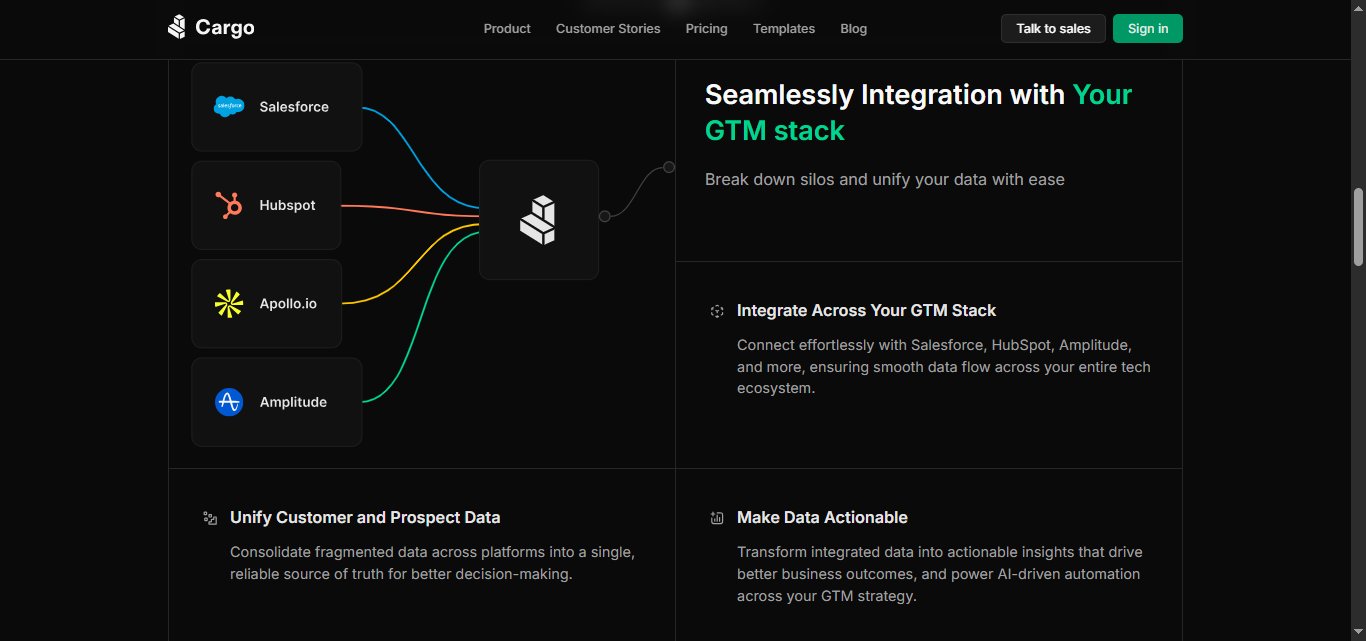
Data Models are Cargo's internal storage layer, functioning as a lightweight CRM-like database that holds enriched lead data, workflow state, and contact history within the platform.
This allows Cargo to act as a data layer that connects and synchronizes with your existing CRM rather than requiring you to manage all state externally. Territory management, lead assignment, and sales rep capacity planning are all handled through Data Models.
Revenue Organization
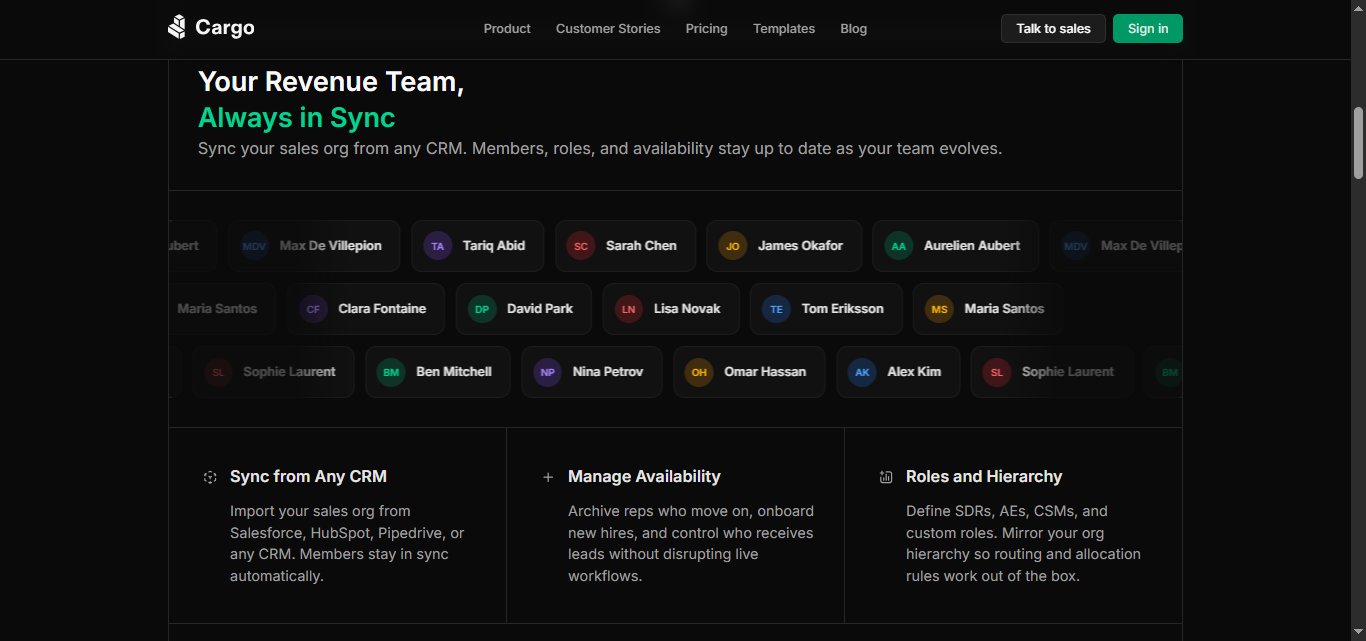
Cargo's Revenue Organization layer handles the operational distribution of leads across sales teams, including territory management, lead assignment rules, and rep capacity balancing.
This is particularly relevant for larger sales organizations where lead routing complexity adds operational overhead that typically requires custom CRM configuration or manual intervention.
Build via UI or Code

Cargo is one of the few platforms in its category that supports both a fully visual no-code interface and a complete programmatic interface via API, CLI, Claude Code, and Cursor. GTM operators can build and deploy agents through the UI without writing code.
GTM engineers can operate the full agent fleet from a terminal, build custom agents, and integrate Cargo into broader data pipelines. Both paths access the same underlying infrastructure.
Cargo Pricing
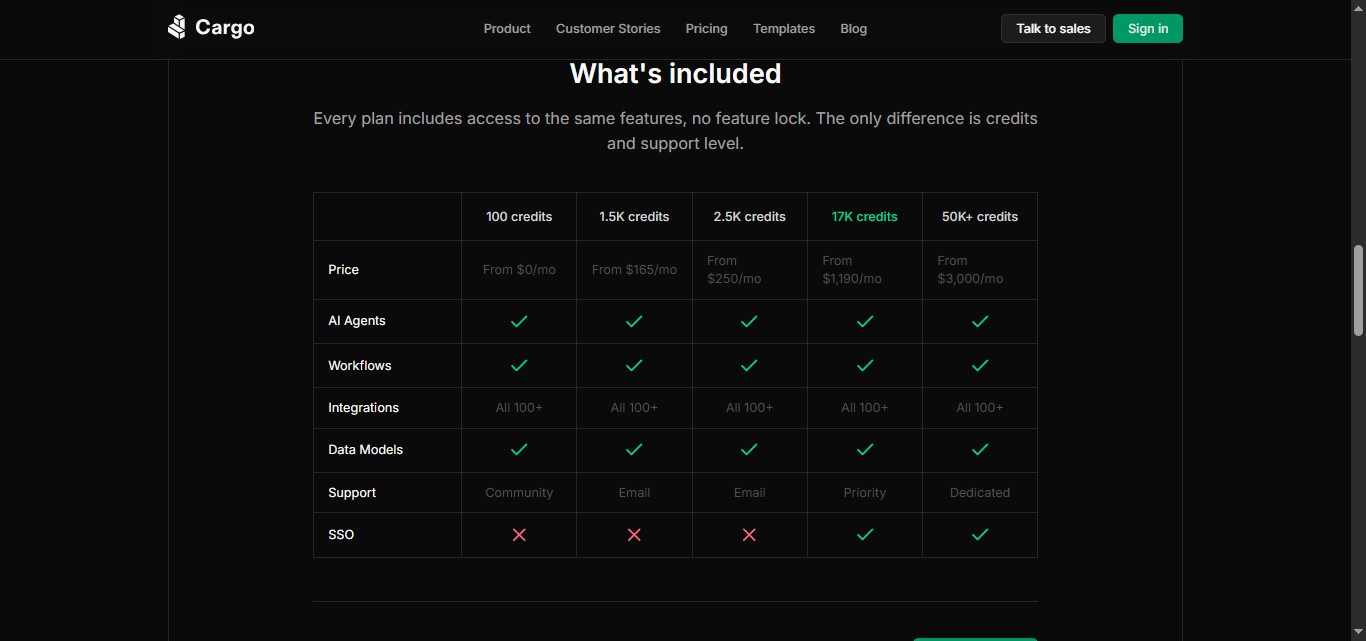
Cargo uses a pure credit-volume pricing model with no feature gating between tiers.
Every plan includes all AI agents, all workflows, all data models, and all 100-plus integrations. The only differences between plans are the credit allocation and the support level.
Credits are consumed across three dimensions: enrichment credits (for data lookups and research), orchestration steps (for workflow actions), and storage inserts (for Data Model writes).
Different workflow actions consume different credit types. Enrichment-heavy workflows burn enrichment credits faster. Complex multi-step orchestrations consume more orchestration steps. High-volume data storage operations consume more storage inserts.
Annual billing is available with a discount. No credit card is required to start the free plan.
Free: $0/month
- 100 enrichment credits (one-time, not monthly)
- 10,000 orchestration steps (one-time)
- 100,000 storage inserts (one-time)
- All AI agents, workflows, data models, and 100-plus integrations
- Community support
- Best for exploring the interface and running initial test workflows
1,500 credits: From $165/month
- 1,500 enrichment credits
- All features included
- Email support
- Best for individuals and very small teams testing the platform at light volume
2,500 credits: From $250/month
- 2,500 enrichment credits
- All features included
- Email support
- Best for small teams running structured outbound at moderate volume
17,000 credits: From $1,190/month
- 17,000 enrichment credits
- All features included
- Priority support
- Best for growing teams running high-volume enrichment and qualification workflows
50,000-plus credits: From $3,000/month
- 50,000-plus enrichment credits
- All features included
- Dedicated support
- SSO included
- Best for enterprise teams and agencies with high-volume, mission-critical GTM workflows
Pricing disclaimer: Cargo's pricing page uses a credit-volume slider rather than fixed named tiers. The credit volumes and prices above are confirmed from the official pricing page as of 2026.
Exact monthly costs depend on the credit volume selected. Annual billing reduces costs below the monthly rates listed. Contact sales for annual pricing and for volumes above 50,000 credits.
What Works Well
✅No feature gating is a genuinely unusual commitment.
Most SaaS tools at this price point reserve key features for higher tiers. Cargo's decision to include all four agent types, all workflows, and all 100-plus integrations on every plan including free means teams can build and test exactly the workflow they need before upgrading for volume.
There is no scenario where a team discovers a feature they need is locked behind a more expensive plan.
✅The multi-agent Play architecture solves a real coordination problem.
The operational handoff between lead research, ICP qualification, and first outreach is where most outbound workflows break down. Someone has to decide which enriched leads meet the qualification bar and route them correctly.
Cargo's ability to automate that entire chain in a single Play, triggered by an external event and running end-to-end without human intervention, addresses a workflow gap that Zapier-based stacks consistently fail to solve cleanly.
✅Both no-code and code-first paths are genuine.
Most tools that claim to serve both non-technical operators and engineers end up serving one poorly. Cargo's visual interface is functional enough for GTM operators to build and deploy agents without engineering help, while the API, CLI, and Claude Code integration give engineers the programmatic control to embed
Cargo into broader data pipelines. Both paths access the same infrastructure.
✅SOC 2 Type II certification and Y Combinator backing reduce enterprise adoption risk.
For teams building critical GTM infrastructure on a newer platform, the combination of institutional security certification and venture validation meaningfully reduces the risk profile compared to building on a bootstrapped tool with no external credibility signals.
✅Weekly integration updates reflect active development. T
he commitment to weekly connector ecosystem updates suggests a product team that is actively responding to customer integration needs rather than treating integrations as a static feature set.
Potential Drawbacks
⚠️The three-dimensional credit model makes monthly costs genuinely hard to predict.
Cargo consumes credits across enrichment, orchestration steps, and storage inserts separately. A workflow that enriches 500 leads, runs qualification scoring on each, writes results to a Data Model, and triggers outreach tasks burns credits from all three pools simultaneously.
There is no flat per-contact cost. Teams cannot accurately estimate monthly spend without either running the workflows first or getting a detailed breakdown from the Cargo team before committing.
⚠️The free plan's 100 one-time credits is not a meaningful evaluation period.
One hundred enrichment credits consumed across enrichment, orchestration, and storage gives most teams enough to run one small test workflow. It is not sufficient to evaluate data quality, agent output, or workflow reliability against a real prospect list.
The jump to the first paid tier at $165/month for 1,500 credits is the minimum needed for a genuine evaluation, but that still represents a financial commitment before teams have meaningful evidence the platform works for their use case.

⚠️The price jump from $250/month to $1,190/month has no intermediate option.
The gap between 2,500 credits at $250/month and 17,000 credits at $1,190/month is the most significant structural limitation in Cargo's pricing. Teams that outgrow 2,500 credits face a near-five-times price increase with no tier in between.
For growing teams whose usage is scaling from light to medium volume, this cliff requires either rationing credits on the lower tier or committing to a budget jump that may not be fully utilized at the point of upgrade.
⚠️The learning curve is steep and genuinely requires technical investment.
Independent reviewers consistently rate Cargo's learning curve as advanced. Building effective multi-agent workflows requires understanding how the three credit types interact, how to configure agent logic, how to chain Plays correctly, and how to structure Data Models for the output you need.
The template library reduces this barrier but does not eliminate it. Most teams report needing one to two weeks of active configuration before workflows run reliably. Cargo is not a plug-and-play tool.
⚠️Near-zero independent public reviews creates significant evaluation risk.
Cargo has zero published reviews on SourceForge, a minimal G2 presence, and no meaningful Reddit or community forum coverage as of 2026. The customer logos on the website are credible, but the absence of independent third-party reviews means there is no way to verify vendor claims about performance, reliability, or ROI without speaking directly to existing customers.
Teams committing $1,190 to $3,000 per month based on vendor-provided evidence alone are accepting meaningful validation risk.
⚠️No native LinkedIn outreach automation.
The SDR Agent handles email-based outreach and task creation. LinkedIn connection requests, automated LinkedIn message sequences, and LinkedIn inbox management are not part of Cargo's native capability. Teams that want LinkedIn alongside email in their outreach motion need to connect an external LinkedIn automation tool and manage that integration separately.
Who Should Use Cargo
Cargo is the right tool for technically capable RevOps teams, GTM engineers, and growth agencies that need to automate complex, multi-step revenue workflows involving data enrichment, ICP qualification, and email-first outreach at scale.
Teams that have already identified their ICP, have documented their qualification criteria, and have the technical capacity to configure agent workflows will get the most value from the platform.
Product-led growth companies managing large volumes of inbound trial users who need automated research and qualification before sales follow-up are a particularly strong fit.
It is a harder sell for teams without a GTM engineer or RevOps specialist who can own the configuration and maintenance of agent workflows, teams whose primary outreach channel is LinkedIn rather than email, organizations that need a flat predictable per-contact pricing model rather than a multi-dimensional credit system, early-stage teams that need an off-the-shelf tool that runs in days rather than weeks, or buyers who need substantial third-party validation before committing to a significant monthly spend.
Cargo vs SalesRobot: A Direct Comparison
SalesRobot: The Natural Complement for LinkedIn Outreach
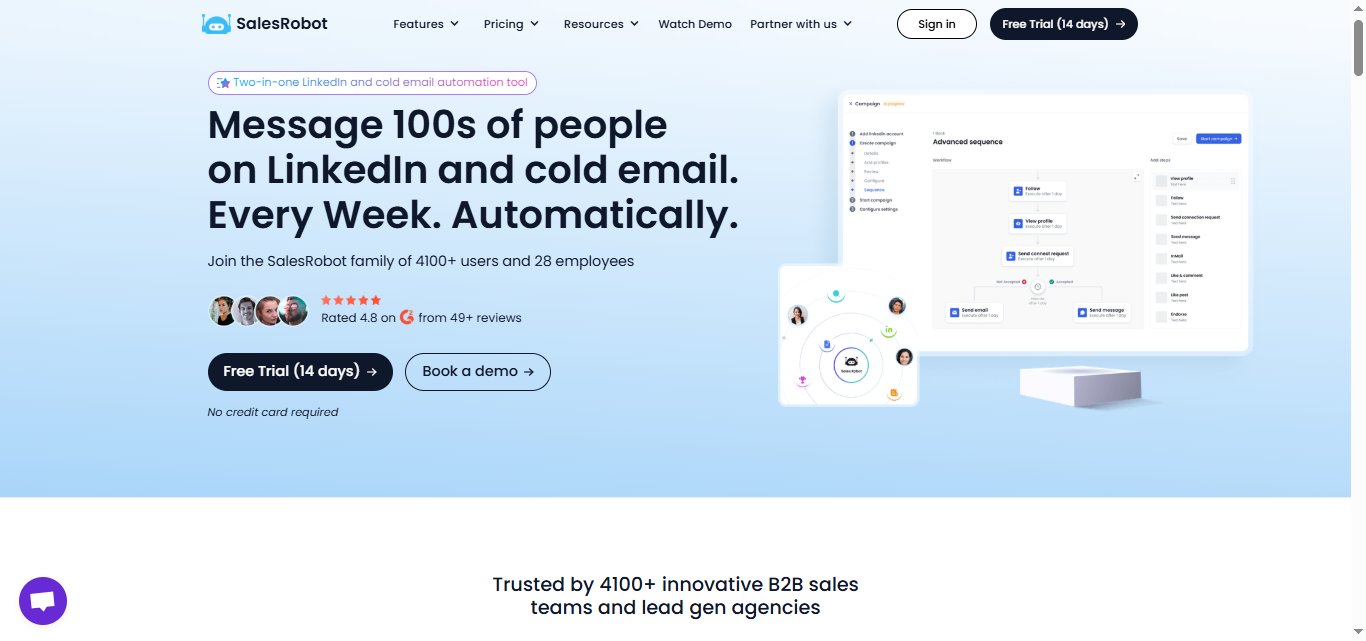
Cargo automates the research, qualification, and email engagement stages of the revenue pipeline.
What it does not cover is LinkedIn, which, for most B2B sales teams in 2026, is not just a data source but a primary outreach channel.
Cargo's SDR Agent handles email-based outreach through connected tools.
For LinkedIn connection requests, personalized follow-up sequences, and inbox management on LinkedIn itself, teams need a dedicated LinkedIn automation tool. SalesRobot fills that gap directly.
SalesRobot is a cloud-based LinkedIn and email automation platform built specifically for B2B outreach.
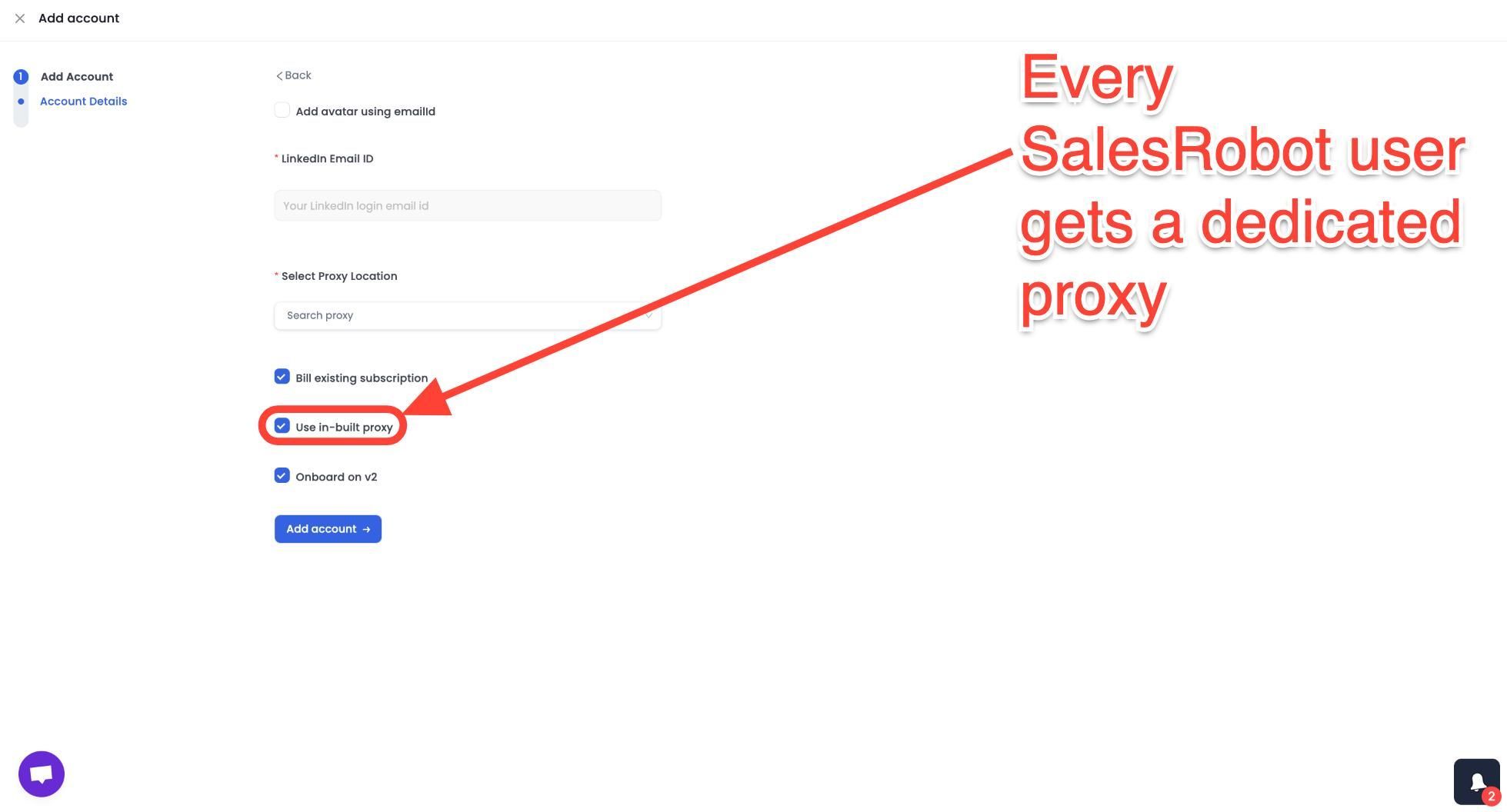
Mobile API Safety: Because SalesRobot connects through LinkedIn's mobile APIs, your outreach activity mimics natural human behavior.
Users consistently report running sustained, high-volume campaigns without account flags or restrictions, which is the single biggest operational concern with any LinkedIn automation tool.
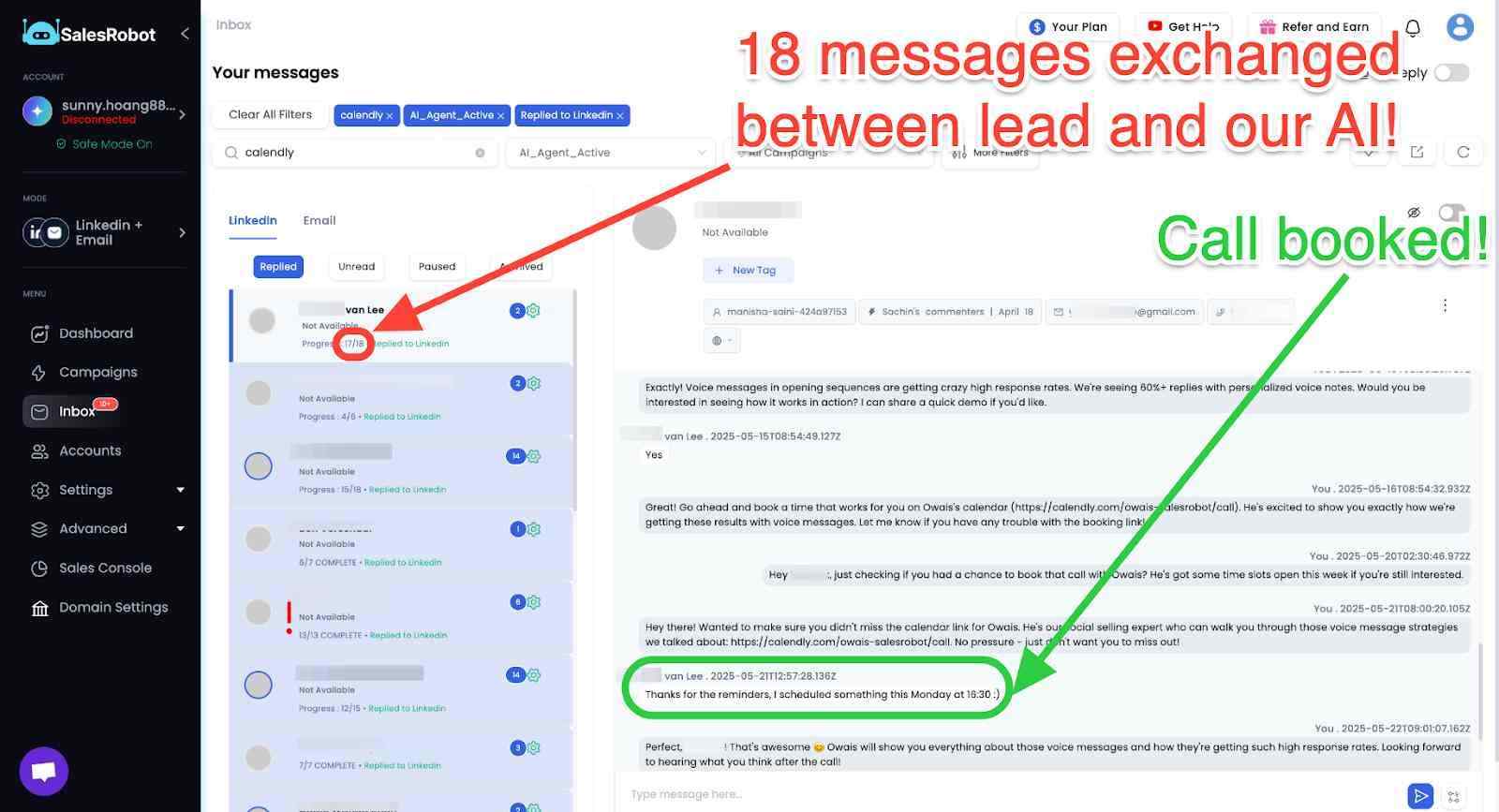
AI Appointment Setter: After a prospect replies, SalesRobot's AI takes over the conversation, handles qualification questions, and books meetings automatically.
You can train it on your specific criteria and ideal responses, which means the early-stage pipeline management largely runs without manual involvement. For smaller teams without a dedicated SDR, this is a meaningful capability.
AI Voice Clone and Video Messages: SalesRobot lets you send personalized voice notes and video messages through LinkedIn as part of automated sequences.
The AI Voice Clone feature lets you record a short voice sample once, then generates individualized voice notes for each prospect that sound like you, without recording each one manually.
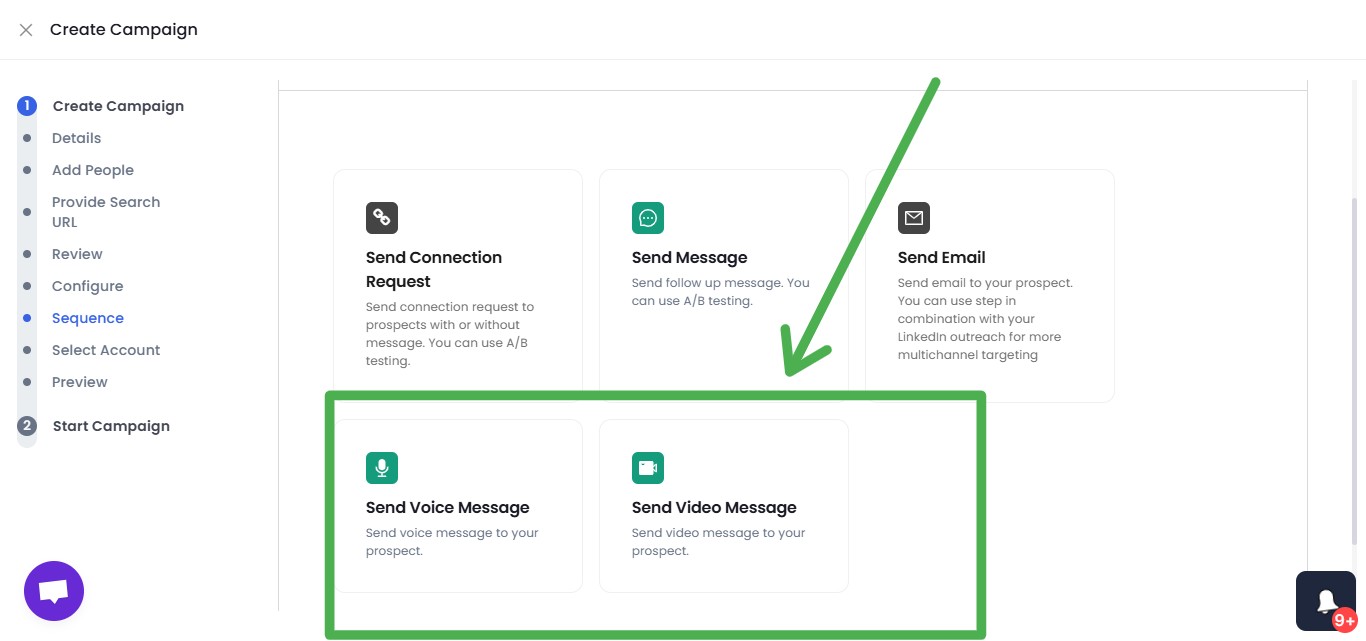
In sectors where relationships and trust matter, this kind of personal touch at scale tends to drive significantly higher reply rates than text-only outreach.
AI Variables and Hyper-Personalization: SalesRobot pulls data directly from a prospect's LinkedIn profile to write personalized message sequences automatically. You are not working from a static template that gets blasted to everyone.
Each message is adapted to the individual, which matters when you are reaching decision makers who see generic outreach constantly.
![SalesRobot interface showing AI variables for creating outreach messages, with options like 'I noticed that [profile observation]' and 'I know you are very busy with X](https://cdn.prod.website-files.com/689b0a925ba9773f34278e0e/69a05b2abd3ecd4e697ba5a1_69281db1da3c69f983bad110_69281c57d108010d7348b243_0a6656d1.jpeg)
Multi-Step Sequences: You can build complex LinkedIn and email campaigns with smart delays and behavioral conditions. Leads can be imported from Sales Navigator, standard LinkedIn search, LinkedIn groups, event attendees, or CSV uploads, giving you flexibility in how you build and target your prospect lists.
Unified Inbox and Mini CRM: All LinkedIn and email conversations consolidate in one place with automatic reply detection. SalesRobot stops messaging automatically when a prospect responds, preventing the over-automation feel that kills conversations. You can tag leads, filter by interest level, and track where every prospect sits without switching between platforms.
Team Management and Analytics: For agencies or sales teams managing multiple LinkedIn accounts, SalesRobot tracks performance across accounts, prevents duplicate outreach between team members, and surfaces detailed analytics on what sequences and approaches are actually working.
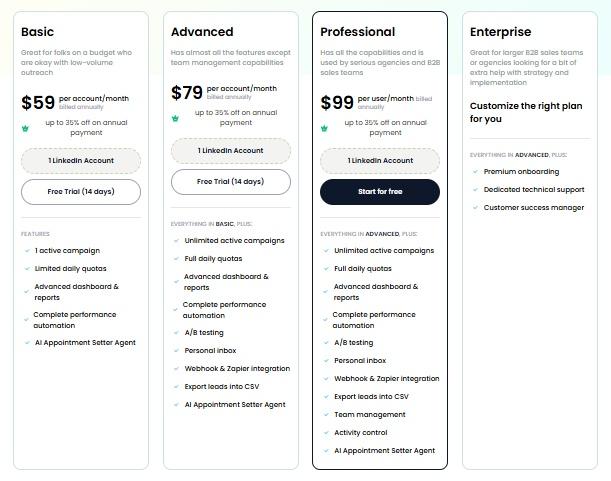
SalesRobot pricing (per LinkedIn account, 14-day free trial, no credit card required):
- Basic: $59/month ($39/month billed annually).
- Advanced: $79/month ($59/month billed annually).
- Professional: $99/month ($79/month billed annually).
- Enterprise: Custom.
It also has a 4.8 rating on G2, with 50+ independent user reviews.
The Bottom Line
Cargo is a genuinely ambitious platform with a strong architectural vision.
✅The no-feature-gating commitment is unusual and customer-friendly.
✅The multi-agent Play orchestration addresses a real coordination problem that simpler automation tools fail to solve.
✅The Y Combinator backing, Series A funding, and SOC 2 certification reduce the adoption risk that comes with building critical infrastructure on a newer platform.
✅For technically capable GTM teams running complex, high-volume revenue workflows, Cargo earns serious evaluation.
The limitations are real and consequential.
❌The three-dimensional credit model makes budget forecasting genuinely difficult. The free plan's 100 one-time credits is not a meaningful trial.
❌The learning curve requires technical investment.
❌Independent reviews are near-zero, meaning buyers must rely primarily on vendor-provided evidence before committing.
If LinkedIn outreach is part of your team's pipeline motion, SalesRobot fills that execution layer directly. Cargo handles the orchestration and email engagement upstream. SalesRobot handles the LinkedIn outreach and meeting conversion downstream. Both are independently testable before any significant commitment, with SalesRobot offering a 14-day free trial and Cargo providing free access to 100 starting credits.
Frequently Asked Questions
Does Cargo do LinkedIn outreach?
No. Cargo's SDR Agent handles email-based outreach and task creation through connected tools like Apollo, Outreach, and Instantly. It has no native LinkedIn connection requests, message sequencing, or inbox management. For LinkedIn outreach, teams pair Cargo with a dedicated tool such as SalesRobot.
How do Cargo's credits actually work?
Cargo uses one usage-based credit balance consumed across three action types: enrichment (data lookups, priced per provider), orchestration (roughly 100 workflow steps = 1 credit), and storage inserts (about 1,000 inserts = 1 credit). Credits reset each term on paid plans, and overages are billed automatically at your plan's rate.
Is Cargo (getcargo.ai) the same as CargoAi or cargo.one?
No. Cargo at getcargo.ai is a San Francisco-based, Y Combinator-backed AI revenue orchestration platform for GTM teams. CargoAi (cargoai.co) and cargo.one are unrelated air-freight booking platforms for logistics. Despite the similar names, they serve entirely different markets and are separate companies.
How long does it typically take to set up and deploy Cargo in production?
For most RevOps and growth teams, initial setup takes between 1 and 2 weeks. While simple pre-built Plays can be deployed in a day, fully configuring custom data models, setting up multi-agent research/qualification scoring logic, and testing credit consumption across enrichment providers require dedicated technical ramp time before running at scale.
How does Cargo compare to visual workflow tools like Make.com or Zapier?
Zapier and Make.com are general-purpose integration platforms that connect applications using static triggers and actions. Cargo is purpose-built for GTM revenue orchestration with a native data layer. It provides pre-built AI agents (Research, Qualification, SDR) designed to evaluate context, reason over firmographic/intent data, and maintain lead state inside Data Models rather than just pushing raw payloads from point A to point B.
Can Cargo replace my existing CRM like Salesforce or HubSpot?
No. Cargo’s Data Models function as a lightweight operational data layer to synchronize and process lead logic before pushing structured results into your CRM. It complements systems like Salesforce and HubSpot by reducing manual CRM data entry and workflow clutter, but it does not replace core CRM functions such as opportunity management, pipeline forecasting, or customer reporting.
What happens if Cargo runs out of credits mid-workflow?
On paid plans, credit usage across enrichment, orchestration, and storage updates in real time. If your usage exceeds your plan tier, overages are automatically billed at your plan's standard rate, ensuring active GTM workflows and lead sequences aren't abruptly paused.
Is Cargo suitable for non-technical sales operators?
Cargo offers a dual interface: non-technical GTM operators can build, launch, and monitor workflows entirely through the visual UI using template Plays. However, getting the maximum ROI out of complex, highly customized workflows often requires RevOps support or familiarity with API endpoints, Webhooks, and data structuring.

Wow your leads by cloning yourself and sending personalized videos and voice notes to each lead on LinkedIn.
If you don't reply to leads within 5 mins, your chances of converting them fall by 50%. Our AI replies on your behalf instantly! (and yes, you can train it)

Don't shoot in the dark. Get detailed analytics on what's working
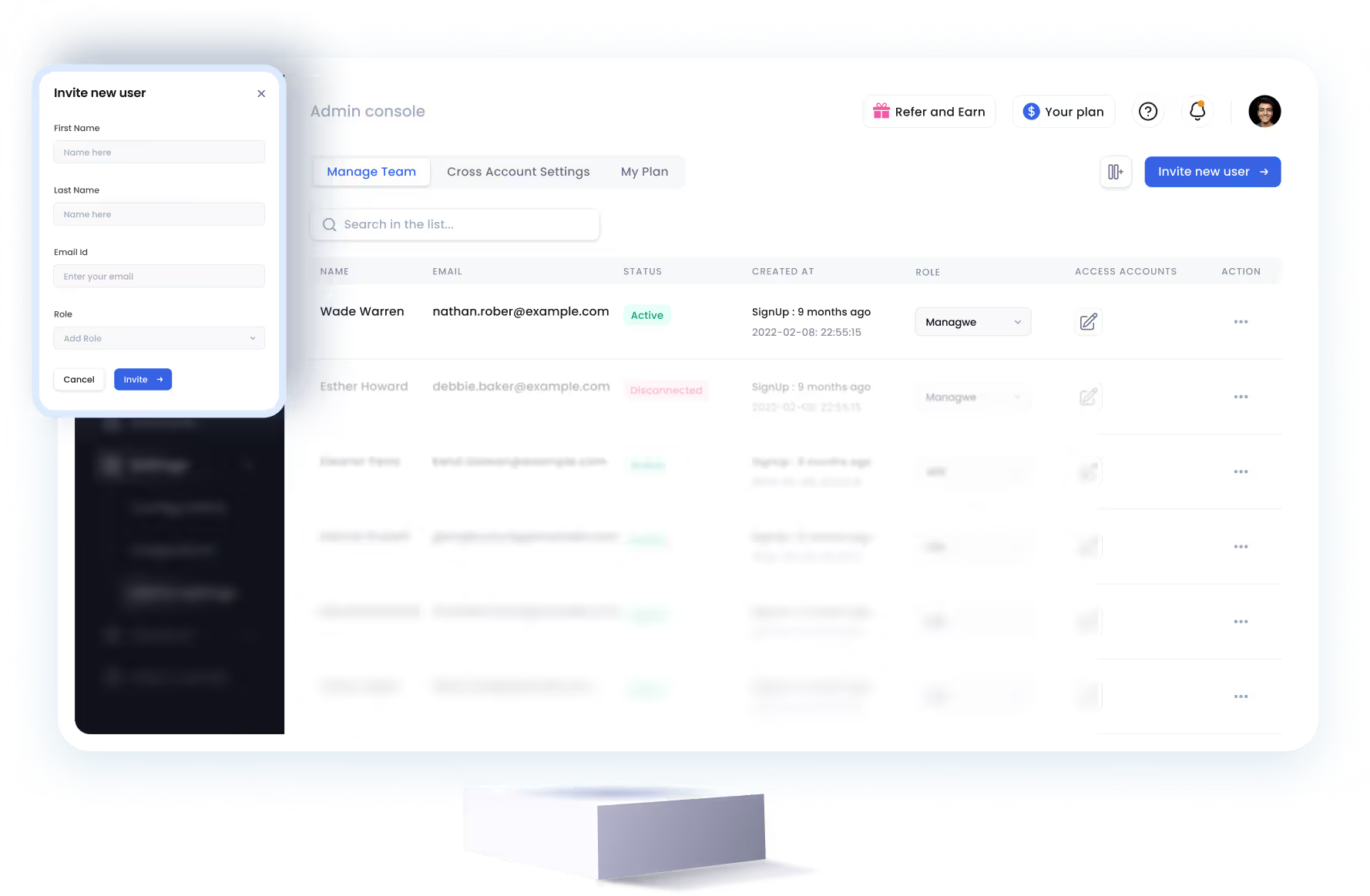
SalesRobot allows you to invite other team members, so that they can add their LinkedIn Account, run outreach campaigns and get amazing results just like you.
.avif)


Trusted by 4100+ innovative B2B sales teams and lead gen agencies

.avif)

.avif)




.avif)


Heading 1
Heading 2
Heading 3
Heading 4
Heading 5
Heading 6
Lorem ipsum dolor sit amet, consectetur adipiscing elit, sed do eiusmod tempor incididunt ut labore et dolore magna aliqua. Ut enim ad minim veniam, quis nostrud exercitation ullamco laboris nisi ut aliquip ex ea commodo consequat. Duis aute irure dolor in reprehenderit in voluptate velit esse cillum dolore eu fugiat nulla pariatur.
Block quote
Ordered list
- Item 1
- Item 2
- Item 3
Unordered list
- Item A
- Item B
- Item C
Bold text
Emphasis

Superscript
Subscript